Paying for it

Almost nobody writes one check.

An accessible vehicle is usually paid for out of three or four sources stacked together — and the order you approach them in changes how much you end up paying. Here's how it actually works, including the parts nobody tells you until it's too late.

Start here

The order matters more than the list.

This is the single most useful thing on this page. Most of the money available for accessible vehicles is awarded before a purchase, not reimbursed after one — and the most common expensive mistake is buying first.

  1. Get the measurements and the evaluation first

    Chair weight with the occupant, seated height, width and length. If the person will drive from the chair, a driver rehabilitation specialist (a CDRS) has to evaluate and prescribe the equipment before anything is ordered — and that evaluation is often funded itself. Nearly every funding route wants to see a professional recommendation, and the recommendation determines the vehicle, not the other way round.

    The nine measurements to take →

  2. Open the slow applications now

    VA claims and vocational rehabilitation cases take months, not weeks. Both can run in the background while you're still deciding what vehicle you want. Starting them early costs nothing and starting them late costs everything.

  3. Get the award or the authorization in writing

    Before you sign anything. Programs that pay a vendor directly generally cannot pay you back for a vehicle you already bought — and a verbal "you'll probably qualify" is not an authorization.

  4. Then order the vehicle, and claim the rebates after

    Manufacturer mobility rebates work the other way round: they reimburse adaptive equipment after purchase, within a set window. They're the one piece that comes last — and the one most people forget to claim at all.

The mistake we see most

Someone buys the vehicle on a Saturday because it's available, then applies for funding on Monday. The funding was real and they no longer qualify for it. If money from any of these sources is part of your plan, tell us before you commit to anything — including if the vehicle you want is ours.

Veterans

VA benefits.

If the disability is service-connected, this is usually the largest single source — and there are two separate benefits, not one. People routinely claim one and never hear about the other.

Benefit one

Automobile allowance

A one-time payment toward a specially equipped vehicle, paid to the seller. As of the rate effective 1 October 2025 it is up to $27,074.99. The figure is adjusted annually, so check the VA's current rate before you plan around it.

Applied for on VA Form 21-4502. A second allowance is only available if the first was used 30 or more years ago, or a natural disaster destroyed the vehicle it bought.

Benefit two

Adaptive equipment grants

Separate from the allowance, and not one-time. These cover modifying a vehicle — power steering and brakes, seats, windows, and lift equipment — and can be used more than once over the years as needs change.

Applied for on VA Form 10-1394. This is the one that keeps working long after the allowance is spent.

Who qualifies

The VA lists specific service-connected conditions, including loss or permanent loss of use of one or both feet or hands; permanent decreased vision of 20/200 or less in the better eye with glasses; a severe burn injury; ALS; and ankylosis in one or both knees or hips. The adaptive equipment grant has somewhat broader eligibility than the allowance.

Full eligibility and the forms: va.gov →

Employment

Vocational rehabilitation.

The most underused route in this whole list, and the one most people have never heard of. Every state runs a vocational rehabilitation agency, and where transportation is a barrier to getting or keeping a job, vehicle modification can fall within what they'll fund.

The logic is employment, not disability on its own. The case has to connect the vehicle to work — getting to a job, keeping one, or running your own business. That framing is the whole game, and it's why the application is worth thinking about rather than dashing off.

These cases are slow and they are opened before purchase, never after. If work is any part of the picture, this is the first call to make.

Utah

Utah State Office of Rehabilitation

Vocational Rehabilitation, part of the Utah Department of Workforce Services. Offices across the state — call to find the one serving your area.

866-454-8397
jobs.utah.gov/usor/vr

Nevada

Nevada Vocational Rehabilitation

Part of the Rehabilitation Division of Nevada's Department of Employment, Training and Rehabilitation. Relevant if you're in Mesquite, Las Vegas or anywhere in Clark County.

vrnevada.org

Arizona

Arizona Rehabilitation Services Administration

Within the Arizona Department of Economic Security. Its vocational rehabilitation program covers preparing for, finding and keeping a job, including job-site modifications.

des.az.gov →

The rest of the stack

Rebates, financing and grants.

Manufacturer mobility rebates

Toyota, Chrysler, Honda and Ford each run a program that reimburses part of the cost of adaptive equipment fitted to a new vehicle. They're claimed after purchase and within a limited window, and the amounts and rules differ by manufacturer and change from year to year.

This is free money that goes unclaimed constantly, usually because nobody mentioned it at the time of sale. We will — ask us to check which program applies to the vehicle you're considering before you take delivery.

Financing

Some lenders write longer terms for mobility vehicles than for ordinary cars, on the reasoning that the conversion holds value differently. Credit unions are often worth a call before a dealer's finance desk.

Worth knowing: the conversion and the base vehicle can sometimes be financed differently, and some funding awards pay the conversion only. Get the two numbers separated before you borrow against a single total.

Non-profit grants

National and regional organizations award grants toward accessible vehicles, often tied to a specific diagnosis, to veterans, or to children. Application cycles are periodic and the awards are competitive, so they reward starting early and applying to several.

Ask us what we've seen work for situations like yours. We won't pretend to know every program, but we know some of them.

What insurance usually doesn't cover

Health insurance and Medicare generally do not pay for vehicle modification — it's treated as transportation rather than durable medical equipment. Medicaid waiver programs vary by state and occasionally do.

If a vehicle was damaged in an accident, though, the conversion is part of its value. Make sure your policy reflects what the conversion cost, not just the base vehicle.

Where we fit

What we can and can't do.

We can give you the quotes and documentation these applications ask for, separate the vehicle cost from the conversion cost so an award can be applied correctly, tell you which manufacturer rebate applies before you take delivery, and hold a build while a funding decision comes through.

We can't file the applications for you, promise an outcome, or advise you on borrowing — we sell vans, we're not financial advisors, and anyone in this industry who tells you they can guarantee funding is telling you something they don't know.

Programs, amounts and eligibility rules on this page change. Everything here was checked against the source in September 2026, but confirm the current terms with the program itself before you plan around a number.

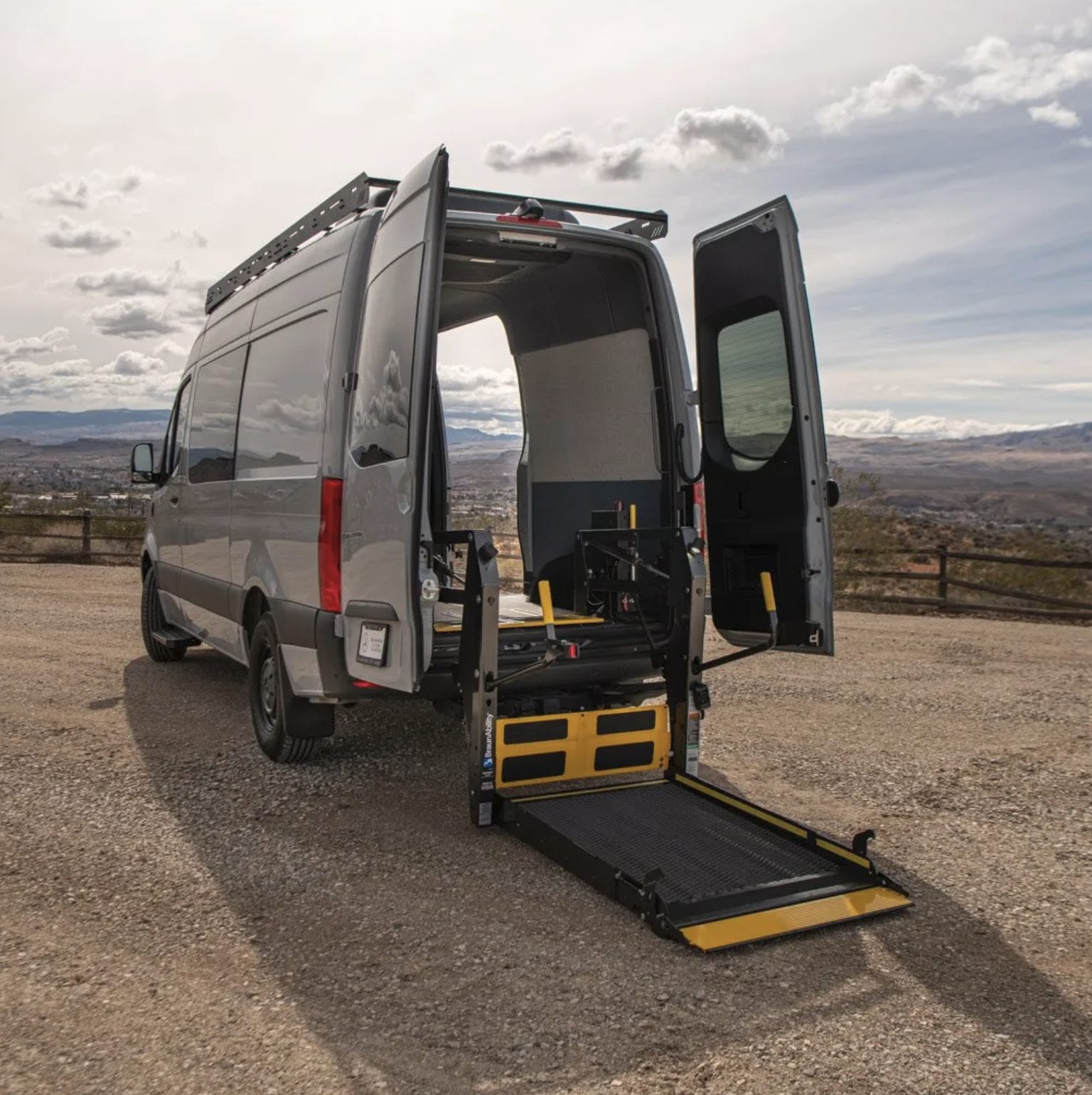
The in-stock silver Mercedes-Benz Sprinter photographed from the rear three-quarter on a gravel overlook, both rear doors open and the BraunAbility platform lift lowered flat to the ground.

Before you buy anything

Call us first. Even if you buy elsewhere.

A ten-minute conversation before you commit can be worth more than anything on this page — and it costs you nothing, including when the answer is that we're not the right shop for you.